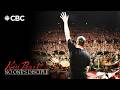
Friday, November 26, 2010

Rush - 1979-01-11 - Boston

This is the track list I would love to hear live!!!

[Capture.JPG]


Master audience recording taped by Dan Lampinski
This is the best sounding audience tape of the 1979 tour and totally uncirculated until a couple of days ago. So download, play loud... annoy the neighbors.


101. Introduction
102. Anthem
103. A Passage To Bangkok
104. By-Tor And The Snow Dog
105. Xanadu
106. Something For Nothing
107. The Trees
108. Cygnus X-1
109. Hemispheres
110. Closer To The Heart

201. Circumstances
202. A Farewell To Kings
203. La Villa Strangiato
204. 2112
205. Working Man
206. Bastille Day
207. In The Mood
208. Drum Solo

Thursday, November 25, 2010

Snowy White: Wailing on the Wall

Adam Perlmutter

Pink Floyd first recruited Snowy White and his ’57 goldtop Les Paul to back them on the road in 1976. Thirty-four years later, vocalist/bassist Roger Waters is still relying on the bluesman and his handful of Boss and Line 6 pedals to pull off an epic presentation of "The Wall."


Sometime in the mid ’70s, Roger Waters, the leader of the progressive rock band Pink Floyd, began to feel a wall developing between the group and its stadium audiences—who were increasingly rowdy and beer-swilling, and seemingly indifferent to the music. This sense of alienation served as the inspiration for Floyd’s epic 1979 double album, The Wall—a rock opera that also addressed some of the other difficult personalities in Waters’ life, including abusive schoolteachers (“Another Brick in the Wall, Part 2”) and an overprotective parent (“Mother”), among others.
Despite its derisive tone, The Wall earned Pink Floyd even larger audiences. A decade after the album was released, more than a quarter of a million fans saw a live concert of the album in its entirety in Germany as Waters and guests like Cyndi Lauper, Van Morrison, and Joni Mitchell celebrated the fall of the Berlin Wall. Now, 20 years after that historic concert, and 30 years after the album was released, Waters has embarked on an ambitious worldwide tour: The Wall Live is playing before packed houses from Toronto to Manchester, England, until June 2011. The mammoth tour features some killer guitarists: former Saturday Night Live mainstay G.E. Smith, Dave Kilminster (known for his work with legendary keyboardist Keith Emerson), and Snowy White, a British instrumentalist steeped in the blues.
White, now 62, got his start as a professional guitarist in early 1970s London. Thanks to his tasteful playing—and to being an affable bloke in general—he made a name for himself on the UK scene without great difficulty. White’s first big gig was a stint as an auxiliary live guitarist for Pink Floyd in the late 1970s, followed in the early ’80s by a slot in the rock band Thin Lizzy.
Since then, White, a consummate pro, has had an enviable career. As a solo artist, he scored a major hit with the 1984 single “Bird of Paradise” from the album White Flames, which is also the name of the band he’s long fronted. At the same time, White has regrouped periodically with Waters for the 1990 Berlin performance ofThe Wall and for Waters’ 2000 In the Flesh tour, among other occasions. Meanwhile, the Snowy White Blues Project finds White in a more straightforward bluesman mode. “I’m lucky, really—I’ve got both worlds here,” he says.
We met up with White in the lobby of a swanky hotel in Manhattan’s SoHo district—which is, appropriately enough, a neighborhood rife with guitar history—to talk about everything from the Wall tour to his blues roots.
How’d you get into the blues?


“I’m not precious about it,” White says of the ’57 goldtop Les Paul he’s relied on for the last 41 years. It’s been rewired and refretted, and the bridge and tuners have been switched out when necessary, but its checked and battered finish bears the battle scars of innumerable gigs. Photo by Snowy White

When I was about 10 years old, I got a guitar from my parents as a birthday present and I learned to play it. Then, in my teens, I heard some blues on the radio and realized that’s the thing I wanted most to play—I wanted to know what it felt like to play those licks and phrases. I didn’t have any lessons or anything. I just sort of worked things out for myself over the years. I didn’t start playing the guitar to become rich and famous—which is good, because I haven’t become rich and famous.
What’s the story behind the goldtop Les Paul that has been with you throughout your entire career?
When I was 18 I met a Swedish girl, so I went to Sweden, because that’s the sort of thing you do when you’re younger—you go where the girlfriend is. I got in a band there—a trio called the Train—and the drummer knew somebody who had a Les Paul for sale. I didn’t know anything about guitars at all—and I still don’t—but I wanted a Les Paul. I had a Stratocaster, which I didn’t like, and I swapped it for the Les Paul— an all-original 1957 goldtop. That was in 1969. I’ve had the guitar for 41 years.
Is it still 100 percent original?
It’s a working guitar, and I’m not precious about it, so I’ve changed things when they needed changing. It’s had different machine heads. It’s been rewired. It’s been refretted a couple of times. And it’s got a different bridge, which I put on because [Fleetwood Mac founder] Peter Green gave it to me, even though it was identical to the original bridge. It’s a fantastic guitar, really true in the neck and fingerboard after all these years—and it sings on every fret just as it should. It’s just lucky, really.


Snowy White has relied on this beautifully battered 1957 goldtop Les Paul since he was 18 years old. Photo by Sean Evans

Since then you’ve branched out a bit from the Les Paul. What are some of the other guitars in your arsenal?
For about 30 years, my Les Paul was my only guitar, and I never wanted another one. But since I’ve been doing other things, like with Roger Waters, I’ve needed a few guitars. I bought a Strat, which is similar to the black Stratocaster David Gilmour has—I figured I would use that for a couple of songs to get the appropriate sound. And on the last tour for Dark Side of the Moon [2006–2008], I bought a ’57 Les Paul reissue, which felt exactly the same as my old one. I put a tremolo arm on it, because I needed to do a few tremolo bits. I also got an ES-345 from Gibson, which is a really great semi-hollowbody. And I’ve got a Martin acoustic, a D-28 that came straight from the factory—they found a nice one for me. So I have bought some guitars I only use when I’m playing with other people. When I’m doing my thing, I just use my Les Paul.
What amps do you prefer?
I used to use a Fender Twin Reverb, but for many years all I’ve used is the Vox AC30. I switched to Vox because it was more complimentary to the sound of my Les Paul. With Roger, even on big stages, I use an AC30. I’ve got two, and I kick the second one in only for solos—that’s it.

1 | 2 | 3 Next »

20 percent of Facebook 'news feed' posts are malware


20 percent of Facebook 'news feed' posts are malwareSecurity company BitDefender has said today that 20 percent of posts that Facebook users see on their "news feed" are actually malware.

60 percent of those attacks come from third-party apps.

22 percent of the malware apps say they will help you see who has been viewing your profile, 15 percent offer "extras" for games you might have like FarmVille, 11 percent offer a "dislike" button (it doesn't exist) and another 7 percent offer links to games.

BitDefender collected its data through the SafeGo Facebook app, which scans user's accounts for malware. SafeGo was launched last month and has 14,000 users.

So far, the software has scanned 17 million posts.

Websense's security tool Defensio says that 1 in every 10 updates that have a link lead to malware


Big Oil Find Is Reported Deep in Gulf 2006

Did BP prevent chevron from gaining access to this oil?


The New York Times


Published: September 6, 2006


An announcement yesterday by three oil companies of a successful production test in the Gulf of Mexico — potentially the largest American oil find in a generation — was seen by experts as ushering in a new era in ultra-deepwater offshore drilling.

ChevronDevon Energy and Statoil ASA, the Norwegian oil giant, reported that they had found 3 billion to 15 billion barrels in several fields 175 miles offshore, 30,000 feet below the gulf’s surface, among formations of rock and salt hundreds of feet thick.

While it is too early to know exactly how big the fields are, the oil companies expressed hope that they had the potential of being even larger than those at Prudhoe Bay, off the northern coast of Alaska.

The United States has reserves of 29 billion barrels, meaning that at the high end of the estimates, the discovery could increase reserves by 50 percent. It comes as the output of oil and gas in shallower wells in the Gulf of Mexico, with about one-quarter of American oil reserves, is ebbing and environmental resistance to offshore drilling in areas closer to coastlines remains strong.


Did BP prevent chevron from gaining access to this oil?

http://www.nytimes.com/2006/09/06/business/worldbusiness/06oil.html?_r=1

The Most Amazing Invention - Burn Salt Water


Can anyone tell me why this is not on every news channel? I never heard about this until today.


The Orb with David Gilmour - Metallic Spheres


Although Metallic Spheres is a three-track EP, it stretches out just shy of an hour. What's more impressive is that the Orb landed David Gilmour in the studio, where he actually played outside on the deck. While many modern musicians hark back to more obvious Floydian influences such as The Wall or anything involving the late, great Syd Barrett, Metallic Spheres recalls those electronic experiments recorded on Ummagumma and the orchestral parts of Atom Heart Mother. Gilmour's lap-steel revives tones last heard with his work on Unicorn's 1974 debut Blue Pine Trees. His guitar is instantly recognizable on "Metallic Side" — so much that he may need to dust off the laser light-show should he ever join the Orb in a live setting. "Sphere's Side" opens with samples of seals under ice from Werner Herzog 2007's documentary Encounters at the End of the World before the Orb's signature ambiance bubbles and blossoms with familiar beats and layered progressions of natural sounds. "The Cult of Youth Ambient Mix, Pts 1 & 2 (Edit)" mashes both movements in a CliffsNotes-esque summation. .

Tuesday, November 23, 2010

The Nordic Sound: 2L Audiophile Reference Recordings Blu-ray

The Nordic Sound: 2L Audiophile Reference Recordings


(2009)

Music


1305_1_tn.jpg1305_3_tn.jpg

1305_5_tn.jpg1305_1_tn.jpgFrom combined musical and audiophile criteria we have compiled the most excellent recordings 2L have to offer. Two of the tracks included in this collection were nominated for the American Grammy Awards "Best Surround Sound Album" and "Best Performance".
Discover what the unique Nordic Sound is all about!

DXD recording, Blu-ray audio only disc + Hybrid SACD.

For more details about The Nordic Sound: 2L Audiophile Reference Recordings on Blu-ray, see The Nordic Sound: 2L Audiophile Reference Recordings Blu-ray Review


The Nordic Sound: 2L Audiophile Reference Recordings Blu-ray, Audio Quality


1305_5.jpg

One of the great advantages of reference-caliber samplers is that they serve as system stretchers to gauge the performance of your gear and any tweaks made to your system. As fate would have it, I had just received a pair of Electra Glide "State of the Union" (SOTU) power cords from manufacturer Scott Hall. Nearly 10 years ago, I found that Electra Glide cords had a significant impact on my system, fleshing out tones from top to bottom and allowing my components to perform optimally. After auditioning several cables, I first settled on the Electra Glide Fatman, which optimized the reproduction of bass as well as the stereo soundstage--an indication of higher frequency performance--showing advantages throughout the dynamic range. Over the years, Hall perfected his cords, moving from the Fatman to the Ultra Khan to the Ultra Kahn II to the Statement, finally evolving to the new SOTU design. The new cords feature many new processes and components, including natural unbleached cotton casing and organic dielectric materials (see photo above).

Evaluating 2L's fantastic recording, Britten's Boisterous Bourree of his "Simple Symphony", using a stock cord powering my Classe Omega SACD2 player, and then using the new SOTU cord, it became apparent that Scott Hall has created an amazing audiophile product. The imaging opened up across the soundstage, delivering more high end detail in addition to midbass presence. The presentation of massed strings was optimized with the SOTU, essentially allowing the digital front end to help the speakers disappear, throwing images effortlessly. Sounds that were stuck to the speakers with the stock cord imaged freely with the SOTU, allowing the recording to shine.

Optimizing one's system is very rewarding when evaluating 2L's recordings. One key to the label's success is that all its engineers have a deep affinity for music and all play instruments themselves. Their ears are developed, their attention to detail is excellent and 2L succeeds where many recording engineers fail--in microphone selection and placement. 2L uses DPA microphones, Millennia Media amplifiers and SPHYNX2 converters to a PYRAMIX station. The label credits Digital eXtreme Definition (DXD) as the digital tool behind its recordings: "a professional audio format that brings 'analogue' qualities in 32-bit floating point at 352.8 kHz." The technology delivers an unprecedented 11.2896 Mbit/s per channel (that's four times the data rate of DSD--the technology behind SACD). According to 2L, this leaves headroom for editing and balancing before quantizing to DSD for SACD or PCM for Blu-ray.

Standout tracks for evaluating one's system include the Arne Nordheim "Colorazione" excerpt, the tracks fromTrondheimSolistene: Divertimenti and for vocal performance, the "Gregorian Chants". So how do the various BD codecs compare to each other and to SACD? First I listened to the 24- bit/192 kHz 5.1 PCM track. I was quickly seduced by the heft of the strings, pianos and voices, and palpability of individual instruments. Nowhere was this more impressive than in Bartók's composition, featuring dramatic shifts of volume, tone and tempi, all imaging gorgeously with the improvements afforded by the SOTU. The midrange liquidity was good, perhaps a touch too sweet and not analytic enough for my taste, but that is the result of the recording venue. I tend to like my recordings a touch drier. But this is a minor quibble and some of the tracks on the sampler provided more reverb than others. Strictly from the perspective of the surround mix, I can't help but feel it is an opportunity lost for the label, but hopefully a 7.1 mix from 2L will be forthcoming. Although 2L engineered Sonar for more conventional five channel surround sound, the mix is anything but conventional.

Though I expected the multichannel SACD content to sound the best of all, it actually performed no better than the lossless PCM content. Perhaps that's because the DSD is converted to PCM and output via HDMI, thereby eliminating any practical advantages of SACD's 2.8 MHz sampling. The DTS-HD MA track was defined, but I noticed it gave up a modicum of tonal realism compared to the PCM track. Overall there was a slightly different tonal character to the aural landscape and less extension on the highs, but it was an almost imperceptible difference. I know the theory that DTS-HD MA is the same as PCM, but I did hear a difference. Perhaps it is attributable to a digital watermark that DTS engineered to ensure the music can be tracked when illegally copied. On the caboose, of course, was the CD layer included on the SACD. Not horrible, but I cannot understand listening to this content when 24/192 PCM is included. Maybe in the car?

Sunday, November 21, 2010

FLUORIDATION - Mind Control of the Masses


FLUORIDATION

Mind Control of the Masses

by Ian E. Stephen

[Extracted from his
self-published booklet "The Dickinson Statement: A
Mind-Boggling Thesis"

published in NEXUS magazine August-September
1995 issue.]
Part 1 | Part 2 | Epilogue | Conclusion
Despite damning evidence on fluoride toxicity, bureaucracies and multinationals continue to pollute our drinking water and mess with our physical and mental health.

Part 1

This story has a beginning, it has a middle but it has no ending. The 'ending' will undoubtedly be written in countless hospital records, on tiny gravestones, in the bones of the crippled and on the hearts of the bereaved. Even so, the true cause of the 'ending' will never be advertised. One record that slipped past the establishment net is duplicated herein but, believe it or not, the existence of this 'death certificate' has been denied, in writing and to overseas scientific inquiry, by Australian administrators. What follows is but a fractional part of the 'middle' of a story that began before the turn of the century and which was provoked by a statement contained in an 'Address in Reply to the Government's Speech to Parliament", as recorded in Victorian Hansard of 12 August 1987, by Mr Harley Rivers Dickinson, Liberal Party Member of the Victorian Parliament for South Barwon. Hence the title.

The relevant Hansard abstract is reproduced herewith. It is emphasised that the writer imputes Mr Dickinson with no other responsibility for the contents of this thesis than being the parliamentary 'trigger' which motivated it and the researched data which it contains.

"At the end of the Second World War, the United States Government sent Charles Eliot Perkins, a research worker in chemistry, biochemistry, physiology and pathology, to take charge of the vast Farben chemical plants in Germany. "While there he was told by the German chemists of a scheme which had been worked out by them during the war and adopted by the German General Staff.

"This was to control the population in any given area through mass medication of drinking water. In this scheme, sodium fluoride occupied a prominent place.

"Repeated doses of infinitesimal amounts of fluoride will in time reduce an individual's power to resist domination by slowly poisoning and narcotising a certain area of the brain and will thus make him submissive to the will of those who wish to govern him.

"Both the Germans and the Russians added sodium fluoride to the drinking water of prisoners of war to make them stupid and docile."

Saturday, November 20, 2010

Rush Time Machine Tour 2011 official announcement!

[gallery columns="2"]

TIME MACHINE TOUR 2011 Rush has confirmed they will be extending the Time Machine Tour and coming to Europe this spring.

The following dates are confirmed, including Rush performing in Ireland for the first time ever.
More additional European announcements to come.

Thursday, May 12th Dublin O2
Saturday, May 14th Glasgow SECC
Monday, May 16th Sheffield Motorpoint Arena
Thursday, May 19th Manchester MEN Arena
Saturday, May 21st Newcastle Metro Radio Arena
Sunday, May 22nd Birmingham LG Arena
Wednesday, May 25th London O2

Rush.com members will be receiving a pre-sale notification on Monday, November 22nd that begins on Tuesday, November 23rd.

TIME MACHINE TOUR 2011

Rush has confirmed they will be extending the Time Machine Tour and coming to Europe this spring.
The following dates are confirmed, including Rush performing in Ireland for the first time ever.
More additional European announcements to come.

Thursday, May 12th Dublin O2
Saturday, May 14th Glasgow SECC
Monday, May 16th Sheffield Motorpoint Arena
Thursday, May 19th Manchester MEN Arena
Saturday, May 21st Newcastle Metro Radio Arena
Sunday, May 22nd Birmingham LG Arena
Wednesday, May 25th London O2

Rush.com members will be receiving a pre-sale notification on Monday, November 22nd that begins on Tuesday, November 23rd.

Tickets for the Time Machine Tour in Ireland & UK general on sale will commence at 9AM GMT on Friday, November 26th, 2010. Ticket links and details will be posted shortly.

Additional European dates will be announced shortly!

Also confirmed today, the Time Machine tour will return to North America for a selection of dates between March and July, primarily with Rush performing in markets not played on the previous tour run this summer.

Stay tuned to rush.com for more details!

Tickets for the Time Machine Tour in Ireland & UK general on sale will commence at 9AM GMT on Friday, November 26th, 2010. Ticket links and details will be posted shortly.

Additional European dates will be announced shortly!

Also confirmed today, the Time Machine tour will return to North America for a selection of dates between March and July, primarily with Rush performing in marketsnot played on the previous tour run this summer.

Stay tuned to rush.com for more details!


Are Scientists Closing in on the Higgs Boson?

Also Known as the "God Particle," the Higgs Boson May Be Real


Aug 6, 2009 Jeremy Small

A Simulated Higgs Boson Event - CERN 
A Simulated Higgs Boson Event - CERN


Scientists with the Fermi National Accelerator Laboratory say their machine has a 50% chance of discovering the particle which is believed to give mass to the universe.


Known as "the God particle," the Higgs Boson is believed to be the last undiscovered atomic particle and is theorized to be responsible for giving mass to the universe. To understand the role of the Higgs Boson is to understand how the atomic world interacts with the world at the macro level where Newtonian physics governs matter. Matter is made of molecules; molecules of atoms and atoms are made of a cloud of electrons about one-hundred-millionth of a centimeter in diameter. The nucleus is made of protons and neutrons which are about two thousand times the mass of an electron. The ratios of particle weight are small but very precise, so much so that scientists like Peter Higgs believed there was a reason for the precision.

Peter Higgs and the Higgs Field


According to his professional website, Peter Higgs currently remains a particle-physics theorist at the University of Edinburgh. He showed in 1964 how to give mass to fundamental particles that would otherwise remain massless. Higgs's work led to the so-called Standard Model of elementary particle interactions which has been confirmed by decades of work at particle physics laboratories around the world, but it also predicted the existence of a mysterious new particle that became known as the Higgs boson. The Large Hadron Collider (LHC) has been built by CERN (The European Organization for Nuclear Research) to search for the elusive boson, a discovery that could lead to Higgs being awarded the Nobel Prize for Physics.

The Higgs field is an energy state that permeates the universe and is the environment for quantum interactions believed to be necessary for mass. The Higgs Boson is a representation of the breaking of symmetries at the quantum level in which massless inputs are responsible for particles which have mass. There are also hints that the mechanics of operation in a Higgs field also may play a role in unifying forces at the atomic level. In addition, the Higgs Boson is the theoretical representation for the process which gives a particle mass. The discovery of the Higgs Boson would be meaningful in terms of unifying theories and attributing mass. Scientists also suggest that lack of evidence for the Higgs Boson would also be scientifically significant in that it would show that a different mechanical model of mass attribution would be necessary that would likely be considered exotic and unexpected.

CERN, Fermi National Accelerator Laboratory and the Tevatron Particle Accelerator


Also working on discovering the Higgs Boson is Fermilab and their Tevatron Particle Accelerator in Batavia, Illinois. "We're not racing CERN," says Fermilab director, Pier Oddone, in New Scientist. He points out that many physicists working at the Tevatron are also heavily involved with the Large Hadron Collider in Europe. Past experiments and theoretical models predict that the Higgs boson has a mass that is equivalent to a value between 114 and 184 GeV (billion electron Volts). This range falls within Tevatron's sensitivity, which suggests that if the Higgs is real, it will only be a matter of time before it turns up at Fermilab.

One thing that will aid physicists is the fact that the Tevatron collides protons with anti-protons. The resulting collisions create less background noise than the proton-proton collisions at LHC are expected to produce. According to co-spokesman Jacobo Konigsberg, a physicist at the University of Florida, Gainesville, "The Tevatron is working beautifully and in the next two years we could double the data taken during the last eight."

The Higgs Boson, Last of the Undetected Particles?


"The Higgs boson is infamous as the only particle predicted by the standard model of physics that remains undetected. In theory, every other particle in the universe gets its mass by interacting with an all-pervading field created by Higgs Bosons. If the Higgs is discovered, the standard model could justifiably claim to be the theory that unifies everything except gravity."

Ultimately, the Higgs Boson represents a large piece of the puzzle of the Unification Theory, which explains the Universe and its forces in one equation that applies to everything from massless particles to large galaxies.

Source

Ananthaswamy, Anil. "Glimpses of the God particle? If the blips in the debris of the Tevatron particle smasher really are signs of the Higgs boson then it's not what we expected. It might mean that it's time to replace the standard model with a more complex picture of the universe." Mechanical Engineering at NU. Northwestern University, 12 June 2007. Web. 12 Aug. 2009. <http://www.mech.northwestern.edu/hartmann/SROP_ScienceDiscussions/2007/Articles/TheGodParticle.html

A Simulated Higgs Boson Event, CERN

Total Pageviews

Popular Posts