Tuesday, January 10, 2012

14 Stunning Pictures from Raceytay Photography

Raceytay has often said, “I don’t take photographs, I make photographs.” Her incredible pictures prove that a background in graphic design can be handy for creating photographic works of art.

To see more photos, visit her etsy shop, Raceytay Photography.

celestial Art sagittarius moon and star trees night

Smile

cranberry red wreath, winter berries black gate

This way wonderland

Deer Antlers

14

Black and red woodland forest

Fiery autumn

Dandelion

Release

Red Poppies

Field of Poppies

tree woodland forest

Hope soars

winter snowflake

In winter with warm tears I'll melt the snow

Monarch Butterfly

Fly away home

Winter Full Moon in January

Wolf moon

Orange Fall Leaves Autumn Foliage

Cambridge dreams

Blue hydrangea with garnet red

Snowneressness

Winter tree yellow sky

Burning sky

Cherry Blossom Orchard

Wonderland

Monday, January 9, 2012

Our Top Posts from 2011

In no particular order, here are 10 of our top posts published during 2011.

21 Cool Frog Pictures

19 Astonishing Northern Lights Pictures

23 Beautiful Kite Pictures

20 Incredible Pictures of Owls

Ben Heine – Pencil vs Camera

25 Brilliant Pictures of Blue

15 Awesome Pictures of Hedgehogs

Stop Motion Animation – Address is Approximate

Why Go Prime? The Benefits of a Fixed Focal Length.

From Me To You – Animated Cinemagraphs by NYC Photographer Jamie Beck

We plan on bringing you even more great articles and inspirations in 2012 to help you become a better photographer.

15 Beautiful Pictures of the Dolomites by Jon Baker

Jon Baker is a photographer based in London, England. He first picked up a camera aged 8, and became fixated with taking pictures of the family pet cat. However Jon’s early enthusiasm for photography was sadly forgotten and he somehow became an accountant! However at the age of 23 Jon took a career break to spend 18 months traveling the world, and during this time he rediscovered his early passion for photography, albeit with a different subject matter. He fell in love with nature and mountainous landscapes and became obsessed with returning to special locations over and over again to capture their natural beauty in perfect light. Jon believes that patience and waiting for the right light are absolutely crucial to creating great images. Jon has developed a particular photographic style, mostly focusing on panoramic images taken with a medium format film camera.

In October 2010, Jon first visited the Dolomites (Dolomiti / Dolomiten), which are a mountain range in north-eastern Italy, and was overwhelmed by the region’s spectacular beauty. He spent 6 months making a photographic study of the area. Here are fifteen of of those beautiful images.

If you want to see more on Jon’s work, check out his website and Facebook.


10 Great Pictures from Alanood Al-Raseed

Alanood Al-Raseed, or Anoodonna as you may know her on Flickr, is a 22 year old management student from Saudi Arabia. She is a member of many photography groups that are mainly interested in the design and editing part of photography. Her love of photography started in 2007, and since then has learned most of her photography skills by herself. Now, she offers training courses in photography basics and high speed photography, and also holds many workshops.

To see more of Alanood Al-Rasheed’s work, check out her website, Fotoblur, and Flickr Photostream.

Little Cowboy

Little Cowboy

Red Umbrella

Red Umbrella

Coca Cola

Coca Cola

Milk vs Coffee

Milk vs Coffee

I miss you

I miss you

Red

Red

Innocence

Innocence

My Dream

My Dream

Pure

Pure

My Small World

My Small World

Ethereal Landscapes by Mike Shaw

Mike Shaw is a Cheshire UK based photographer, self taught and specializing in landscape and street portraits using the chiaroscuro style at times – but likes to move about genres to test his abilities.

He has gone on to develop photographic techniques by crossing over editing software that has given him a style that is uniquely his.

Looking to broaden his horizons and travel more around the globe to try and capture images of his own that reflect his outlook and to show the rest of the world what he sees.

You can connect with Mike via Facebook and Google+ for some fantastic photography from an established pro – and also read some of his incredible photography revelations and tips.

Ethereal Landscapes by Mike Shaw

Ethereal Landscapes by Mike Shaw

Ethereal Landscapes by Mike Shaw

Ethereal Landscapes by Mike Shaw

Ethereal Landscapes by Mike Shaw

Ethereal Landscapes by Mike Shaw

Ethereal Landscapes by Mike Shaw

Ethereal Landscapes by Mike Shaw

Ethereal Landscapes by Mike Shaw

Ethereal Landscapes by Mike Shaw

Geek Trivia: What Was The First Video Game?


sshot4ebe8f8574012.png

What Was The First Video Game?


  • 1) Odyssey

  • 2) Tennis for Two

  • 3) Galaxy Game

  • 4) Pong


Think you know the answer?sshot4f0b0d4e87c47.jpg
Answer: Tennis for Two

Most people, when pressed for the name of the first video game, usually throw out the name of the oldest arcade game they’ve ever played (or had been nostalgically told about by an older friend or relative). Pong, Pac Man, and Asteroids are all early games that come to mind–all relics of the 1970s and 1980s. To find the first video game, however, you need to dig deeper–all the way back to the 1950s.

In 1958 William Higinbothan, an American physicist in the employ of the Brookhaven National Laboratory, created Tennis for Two in order to entertain and amuse visitors. He intended the simple game to serve as a way to capture the interest of the public and create interest in the more scientific endeavors undertaken at Brookhaven.

Higinbothan was inspired to create the game while reading the manual for a small analog computer; the manual included instructions on how one could use it to generate curves on an oscilloscope screen simulating missile trajectories and bouncing balls. Bouncing balls sounded a lot like the game of tennis, people loved tennis, and anything that could combine the research and equipment at Brookhaven with something the public enjoyed and understood seemed like a natural pick for a public display. Higinbothan set to work rigging a series of analog computers and transistor circuits together to feed images into the oscilloscope. The game was simple, there was a net, a ball that bounced over the net, and a large aluminum controller that allowed visitors to hit the ball over the net. Tennis for Two was an enormous success–the entire experience was completely new to visitors at Brookhaven and people would line up by the hundreds to play the game.

Like all firsts, the first-video-game status of Tennis for Two has been subject to quite a bit of debate over the years. As early as the 1940s there was a device called the Cathode-Ray Tube Amusement device, patented by Thomas T. Goldsmith. Although it was in fact a game and loosely resembled early video games, it required physical overlays to be placed on the screen and did not render its own graphics–not the first video game but certainly a sort of prototypical ancestor to it. Seven years before Tennis for Two, the Nimrod Computer was built for Britain’s Exhibition of Science. The Nimrod computer was built not as a game but as a demonstration of computing power–it simply used the centuries-old logic game Nim to show off–perhaps one of the earliest examples of a demo kit but definitely not the first video game as it didn’t even have a screen-based display. The first game of any sort to use a digital graphical display appeared a year later in 1952. Dubbed Noughts and Crosses (or Tic-Tac-Toe as Americans call the game) it again was designed for demonstration/research purposes and not to be played simply as a game. Noughts and Crosses creator A.S. Douglas designed the game in order to study human-computer interactions in a research setting.

Later on, in the 1970s and 1980s, there were a series of lawsuits that established that a “video game” was an apparatus that displayed a game via the manipulation of video display signals of raster-based equipment such as a television set or a computer monitor. By this definition nearly everything prior to 1970 would not be considered a video game. None the less, Tennis for Two was a computer game, designed simply for entertainment, that included a control interface custom designed for play, and it rendered its own graphics. It was a rudimentary and enjoyable Pong nearly a quarter of a century before Pong would be a household name.


readmore-button.png

mf.gif


emailthis2.gifbookmark.gif


a2.img

HowToGeek?i=syrKOAVQti4:9Lp-n76FsBU:F7zBnMyn0Lo HowToGeek?i=syrKOAVQti4:9Lp-n76FsBU:gIN9vFwOqvQ HowToGeek?d=qj6IDK7rITs HowToGeek?d=yIl2AUoC8zA
syrKOAVQti4

Saturday, January 7, 2012

Test Your PC’s Stability

Testing a PCs stability makes sense in a number of situations. Maybe you have made the decision to overclock your PC and want to make sure that everything runs well and stable, or you are thinking of giving away your old PC to a friend or family member who is not the most knowledgeable person when it comes to computers. Making sure that the system runs fine can save you troubleshooting sessions later on.

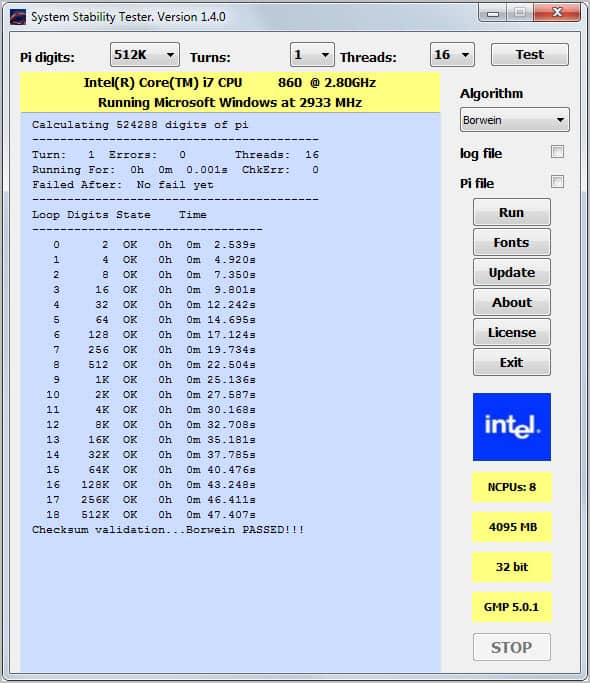
System Stability Tester is a free open source software for Windows, Linux and Mac systems that can stress test and benchmark a computer system. It does so by calculating up to 128 million digits of Pi which is extremely taxing for the processor.

When you first start the program you have the choice to run a benchmark or system stress test. A benchmark can be used to compare the results of a system to another system, the stress test to verify that there are no calculation errors.

You can also select the amount of Pi digits you want to compute, the turns, and the number of threads the computer should use for that task.
system stability tester

The stress testing application supports two pi computation algorithms: The Quadratic Convergence of Borwein and Gauss-Legendre with Borwein being selected by default.

Please note that you can only run a stress test if at least two threads are selected. The program then starts the calculation which can slow down the PC considerable during operation. Statistics are updated regularly that display the amount of calculated Pi digits, the state, and time it took to calculate them.

An overview at the top highlights the total amount of errors of the calculation as well as the processing time until the first error was detected.

You can optionally save a log file or a Pi file. The first saves basic information about the run, the second all Pi digits.

One of the core advantages of System Stability Tester is that it is available for Mac, Linux and Windows systems, which means that it can be used to compare the performance of computers running different operating systems.

Interested users can download System Stability Tester from the developer website over at Sourcerforge.

Total Pageviews

Popular Posts